

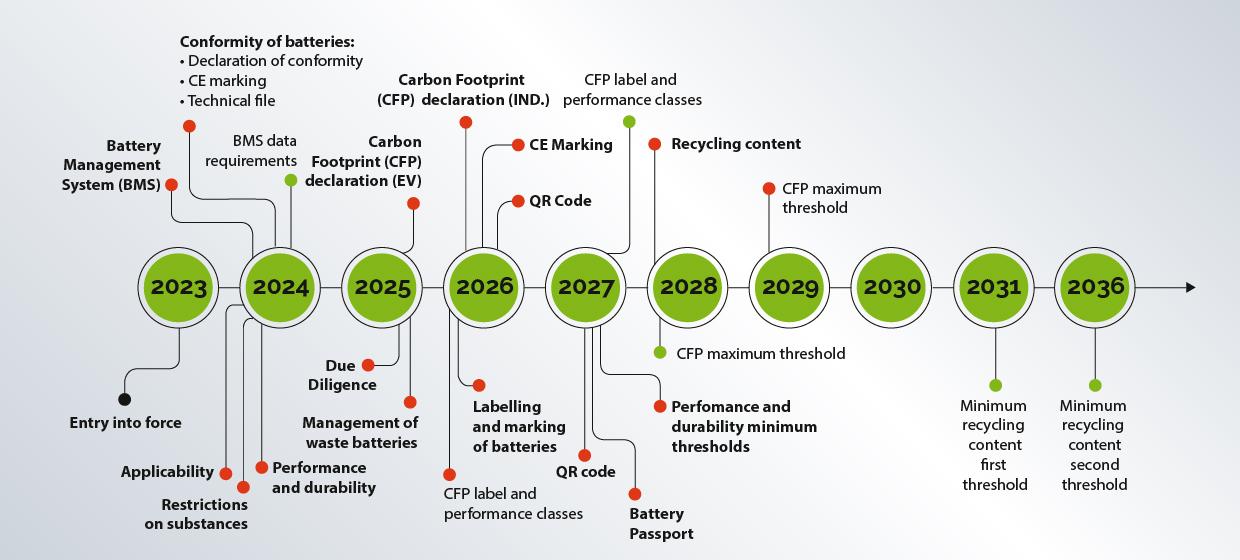
The European Union is continuing to strengthen its regulatory framework for batteries and waste batteries. Under Regulation (EU) 2023/1542, commonly known as the EU Battery Regulation, battery manufacturers, importers, distributors and other economic operators are facing a series of new requirements covering sustainability, safety, labeling, carbon footprint, recycling and digital information.
The regulation applies to batteries placed on the EU market or put into service, regardless of where they are manufactured, with specific exemptions provided by the regulation. Its objective is to improve the sustainability, safety and circularity of batteries throughout their entire life cycle.
Key EU Battery Regulation Milestones in 2026
Several important compliance milestones are relevant to the battery industry in 2026.
Carbon Footprint Requirements
One of the major developments in 2026 is the expansion of carbon footprint requirements.
From 18 February 2026, carbon footprint declaration requirements apply to rechargeable industrial batteries covered by Article 7 with a capacity greater than 2 kWh, subject to the specific conditions and scope of the regulation. These requirements build on the earlier carbon footprint requirements for electric vehicle batteries.
The carbon footprint approach is intended to provide greater transparency regarding the environmental impact of battery production and the battery life cycle.
For battery manufacturers, this means that environmental data, production processes and supply-chain information are becoming increasingly important parts of battery compliance.
New Battery Labeling Requirements
Another important milestone is 18 August 2026.
Under Article 13 of Regulation (EU) 2023/1542, batteries are subject to new labeling and marking requirements, including general battery information and, for rechargeable portable batteries, LMT batteries and SLI batteries, information concerning battery capacity. The exact application date is linked to the relevant implementing act on harmonised labeling specifications, so manufacturers should verify the latest regulatory status before finalizing label artwork.
For battery manufacturers and their customers, this means that product labels may need to be reviewed and updated to ensure that the required information is clearly provided.
Battery labels are becoming an increasingly important part of product compliance in the European market.
Battery Information and QR Codes
Digital information is another major development under the EU Battery Regulation.
The regulation introduces QR-code-based access to battery information. From 18 February 2027, QR-code requirements will apply to batteries, with the information accessible through the QR code depending on the battery category. For electric vehicle batteries, LMT batteries and industrial batteries above 2 kWh, the QR code will provide access to the Digital Battery Passport.
The Digital Battery Passport is designed to improve battery traceability and transparency by connecting a physical battery with relevant digital information.
This may include information related to:
- Battery identification
- Manufacturer information
- Battery category
- Material composition
- Carbon footprint
- Recycled content
- Performance and durability
- Safety information
- Supply chain information
- End-of-life management
The Digital Battery Passport will become mandatory from 18 February 2027 for electric vehicle batteries, LMT batteries and industrial batteries with a capacity greater than 2 kWh.
Sustainability and Battery Recycling
The EU Battery Regulation takes a life-cycle approach to battery sustainability.
The regulation aims to reduce the environmental impact of batteries by encouraging lower carbon footprints, responsible use of raw materials and improved collection, reuse and recycling of waste batteries.
Battery recycling is therefore becoming an increasingly important consideration for manufacturers and businesses operating in the European market.
Future requirements will also address recycled materials and the recovery of important materials such as lithium, cobalt, nickel and lead.
What Does the Regulation Mean for Battery Manufacturers?
For lithium battery manufacturers, the new regulatory framework means that compliance should be considered throughout the product development and manufacturing process.
Manufacturers should pay particular attention to:
1. Product labeling
Battery labels should be reviewed against the latest EU requirements.
2. Technical documentation
Manufacturers should maintain appropriate technical and conformity documentation for products placed on the EU market.
3. Carbon footprint data
For batteries within the applicable scope, manufacturers need to prepare the required carbon footprint information and declarations.
4. Battery traceability
Manufacturers should improve product identification and supply-chain data management in preparation for future digital requirements.
5. QR code and digital information
Companies supplying batteries to the EU should begin preparing the digital information infrastructure required for the upcoming QR-code and Battery Passport requirements.
6. Recycling and end-of-life management
Battery manufacturers and other economic operators should pay greater attention to collection, recycling and end-of-life requirements.
Preparing for the 2027 Battery Passport
Although the Digital Battery Passport becomes mandatory in 2027 for certain battery categories, manufacturers should not wait until 2027 to begin preparing.
A Battery Passport requires structured and reliable product information. Companies may therefore need to establish internal processes for collecting, managing and updating battery data.
For manufacturers supplying batteries to European customers, early preparation can help reduce compliance risks and avoid last-minute changes to product labels, documentation and digital systems.
Conclusion
The EU Battery Regulation represents a major shift toward more sustainable, transparent and traceable battery products.
In 2026, important requirements concerning carbon footprint declarations and battery labeling are being introduced, while the industry is preparing for the broader implementation of QR codes and Digital Battery Passports in 2027.
For lithium battery manufacturers, understanding these requirements early is important for maintaining access to the European market and supporting customers with compliant battery solutions.
As the European battery regulatory framework continues to evolve, manufacturers should regularly monitor regulatory updates and review their products, documentation, labeling and digital information systems accordingly.