

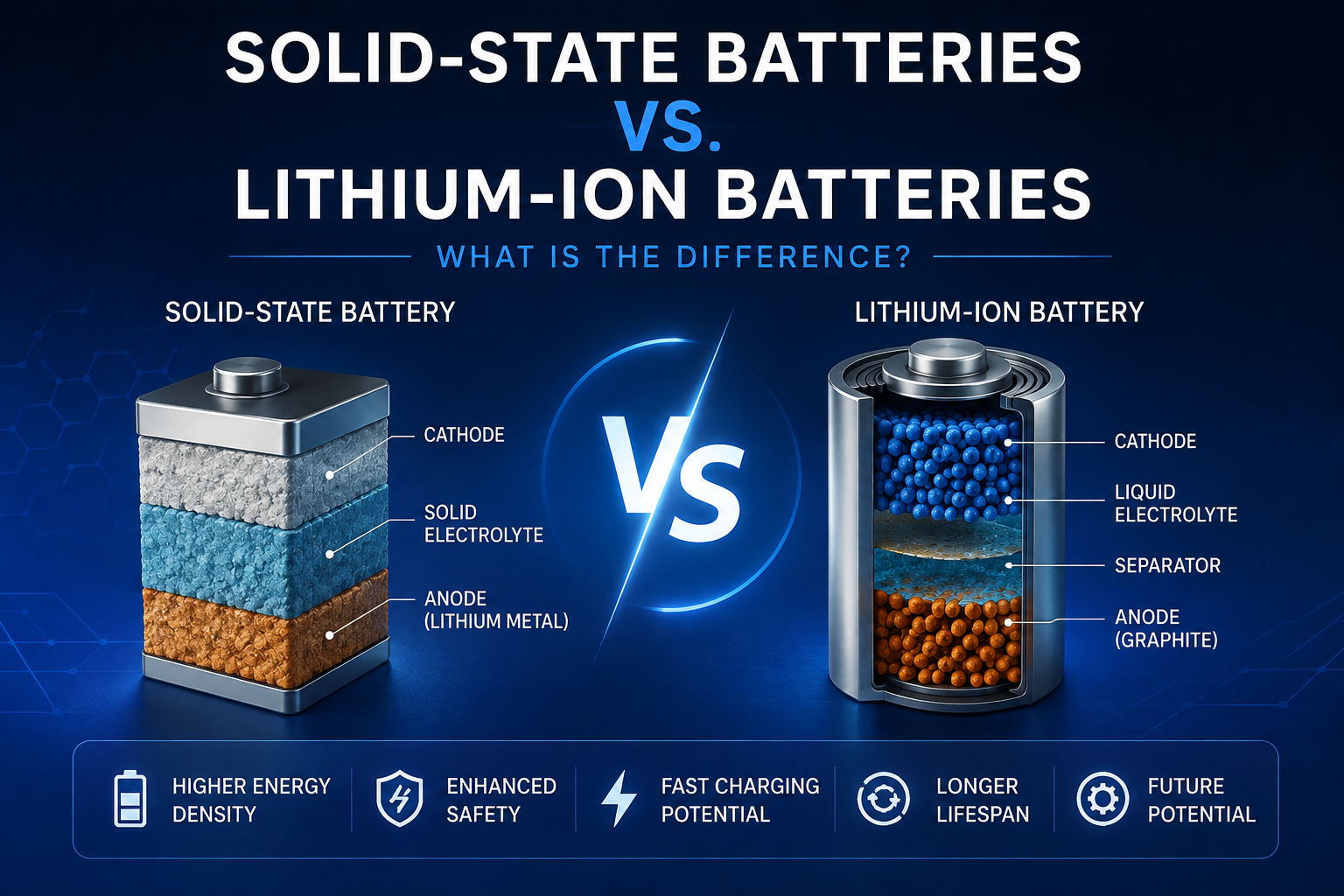
Solid-State Batteries vs. Lithium-Ion Batteries: What Is the Difference?
As demand for safer, higher-performance and more energy-dense batteries continues to grow, solid-state batteries have become one of the most closely watched technologies in the global battery industry.
Lithium-ion batteries, meanwhile, remain the dominant rechargeable battery technology and are widely used in smartphones, laptops, wearable devices, electric vehicles, energy storage systems, IoT devices and many other applications.
So, what is the difference between solid-state batteries and conventional lithium-ion batteries? What are the advantages and limitations of each technology?
What Is a Lithium-Ion Battery?
A lithium-ion battery is a rechargeable battery that uses lithium ions to transfer between the positive and negative electrodes during charging and discharging.
A typical lithium-ion battery consists of several key components, including:
- Cathode
- Anode
- Electrolyte
- Separator
- Current collectors
The electrolyte in conventional lithium-ion batteries is generally a liquid electrolyte. During operation, lithium ions move through the electrolyte between the cathode and anode, while electrons flow through the external circuit to provide electrical energy.
Lithium-ion battery technology has been commercially developed for decades and has benefited from significant improvements in energy density, cycle life, manufacturing efficiency and cost.
Today, lithium-ion batteries are widely used in consumer electronics, electric vehicles, medical devices, power tools, energy storage systems and IoT products.
What Is a Solid-State Battery?
A solid-state battery is a type of battery that uses a solid electrolyte instead of the liquid electrolyte commonly found in conventional lithium-ion batteries.
Depending on the design, solid-state batteries may use different solid electrolyte materials, including ceramic, sulfide-based or polymer-based materials.
One of the main objectives of solid-state battery development is to improve energy density and safety while reducing some of the limitations associated with conventional liquid-electrolyte battery systems.
Solid-state batteries may also enable the use of lithium-metal anodes in certain designs, which could potentially increase energy density.
However, solid-state battery technology is still developing, and challenges remain in areas such as manufacturing, material compatibility, interface stability, production yield and cost.
Solid-State Batteries vs. Lithium-Ion Batteries
Although both technologies rely on the movement of lithium ions in many designs, their internal structures and materials can be significantly different.
1. Electrolyte
The most fundamental difference is the electrolyte.
Conventional lithium-ion batteries typically use a liquid electrolyte, while solid-state batteries use a solid electrolyte.
The solid electrolyte can potentially reduce certain safety risks associated with flammable liquid electrolytes and may allow new cell designs.
However, solid electrolytes also introduce new technical challenges, particularly at the interfaces between the electrolyte and electrodes.
2. Energy Density
Energy density is one of the major advantages expected from solid-state battery technology.
Higher energy density means that a battery can store more energy within the same weight or volume.
Some solid-state battery designs may use lithium-metal anodes, which have a much higher theoretical specific capacity than conventional graphite anodes.
This creates the potential for significantly higher energy density.
Nevertheless, actual energy density depends on the complete cell design, materials, manufacturing process and operating conditions. Therefore, theoretical performance should not be confused with commercially available battery performance.
3. Safety
Safety is another important area of comparison.
Conventional lithium-ion batteries contain flammable organic liquid electrolytes. If a cell is severely damaged, improperly manufactured, overcharged or exposed to abnormal conditions, it can potentially experience internal short circuits and thermal runaway.
Solid-state batteries replace the conventional liquid electrolyte with a solid electrolyte, which may reduce certain risks related to electrolyte leakage and flammability.
However, solid-state batteries are not completely risk-free. Mechanical damage, manufacturing defects, lithium dendrite formation and other failure mechanisms may still affect battery safety.
Therefore, battery safety depends not only on the electrolyte but also on cell design, materials, manufacturing quality, battery management systems and operating conditions.
4. Charging Performance
Fast charging is another important research area for solid-state batteries.
Solid-state battery developers are working to improve ionic conductivity and electrode-electrolyte interfaces to support faster charging.
However, charging performance depends on many factors, including electrolyte conductivity, electrode materials, cell structure, temperature and battery management strategies.
Conventional lithium-ion batteries already offer highly optimized charging performance, and modern lithium-ion technologies continue to improve.
Therefore, solid-state batteries should not automatically be considered faster-charging than all lithium-ion batteries.
5. Cycle Life
Battery cycle life refers to how many charge and discharge cycles a battery can complete before its capacity decreases significantly.
Solid-state batteries have the potential to achieve long cycle life, but their actual performance depends heavily on material selection and cell architecture.
Interface degradation between solid electrolytes and electrodes remains an important technical challenge.
Conventional lithium-ion batteries, on the other hand, have well-established manufacturing processes and extensive real-world operating data. Depending on the chemistry and application, many lithium-ion batteries can provide excellent cycle life.
6. Manufacturing Cost
Cost is currently one of the major challenges for solid-state batteries.
Conventional lithium-ion batteries benefit from mature supply chains, large-scale manufacturing facilities and highly optimized production processes.
Solid-state battery manufacturing may require new equipment, materials and production techniques.
Manufacturers also need to overcome challenges related to production yield, material processing and large-scale quality control.
As production technology develops and manufacturing volumes increase, the cost of solid-state batteries could potentially decrease.
Comparison at a Glance
| Feature | Solid-State Battery | Conventional Lithium-Ion Battery |
|---|---|---|
| Electrolyte | Solid electrolyte | Usually liquid electrolyte |
| Energy Density | Potentially higher | Mature and continuously improving |
| Safety | Potential safety advantages | Mature safety technologies |
| Charging | Under active development | Mature fast-charging solutions |
| Cycle Life | Potentially high | Well established |
| Manufacturing | More challenging | Highly mature |
| Cost | Currently relatively high | More competitive |
| Commercialization | Developing | Widely commercialized |
Are Solid-State Batteries Better Than Lithium-Ion Batteries?
Not necessarily.
Solid-state batteries offer promising advantages, particularly in areas such as energy density and safety. However, conventional lithium-ion batteries currently have significant advantages in manufacturing maturity, supply chain availability, cost and commercial experience.
For many applications, lithium-ion technology remains the most practical choice.
The best battery technology depends on the specific application requirements, including:
- Required energy density
- Available space
- Weight limitations
- Operating temperature
- Required cycle life
- Charging requirements
- Safety requirements
- Production volume
- Target cost
For example, compact lithium-ion and lithium-polymer batteries remain widely used in wearable devices, IoT products, medical equipment, portable electronics and other applications where customized size, shape and performance are important.
What Is the Future of Solid-State Batteries?
Solid-state batteries are expected to remain an important area of research and investment in the global battery industry.
Battery manufacturers and technology companies are working to improve solid electrolyte materials, electrode interfaces, manufacturing processes and production scalability.
The transition from laboratory-scale cells to mass production is one of the biggest challenges facing the technology.
At the same time, conventional lithium-ion battery technology will continue to evolve. Improvements in cathode materials, anode materials, electrolyte formulations, battery management systems and manufacturing processes are expected to further improve lithium-ion battery performance.
Therefore, the future battery market is unlikely to be dominated by a single technology. Different battery chemistries and architectures may coexist for different applications.
Conclusion
Solid-state batteries and lithium-ion batteries each have their own advantages and challenges.
Solid-state batteries offer promising opportunities for higher energy density and improved safety, while conventional lithium-ion batteries benefit from mature technology, established supply chains, competitive costs and extensive commercial experience.
For battery manufacturers and product developers, the right choice should be based on the actual requirements of the application rather than simply choosing the newest technology.
As battery technology continues to evolve, both solid-state and lithium-ion batteries are likely to play important roles in the future of energy storage and electrification.