

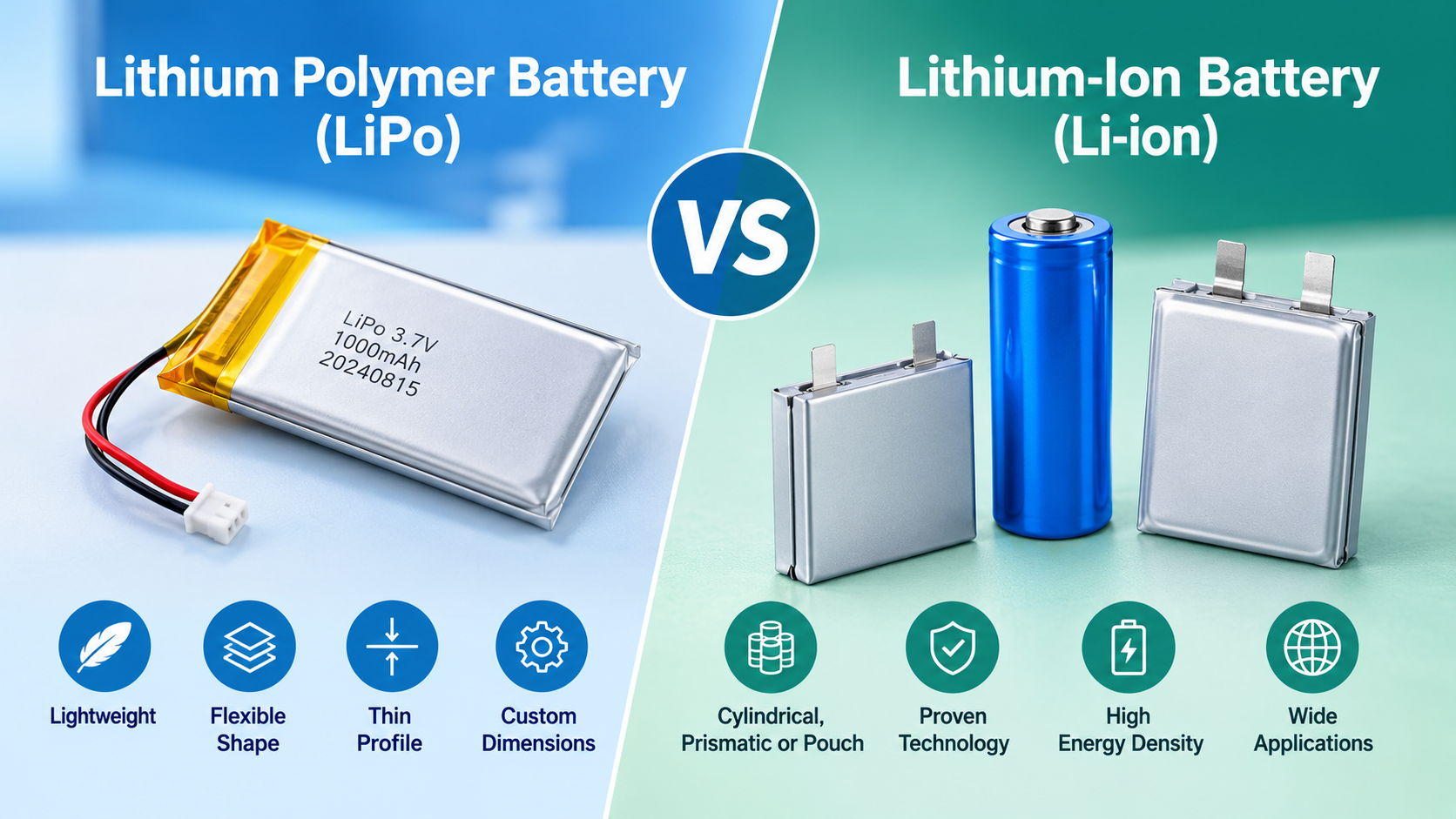
Lithium Polymer Battery vs. Lithium-Ion Battery
Lithium polymer batteries and lithium-ion batteries are two of the most widely used rechargeable battery technologies in modern electronic devices. They are used in smartphones, tablets, wearable devices, IoT equipment, medical devices, portable electronics, power tools and many other applications.
Although both technologies use lithium ions to store and release electrical energy, there are important differences in their construction, form factor, electrolyte system, performance characteristics and typical applications.
Understanding these differences can help product designers and manufacturers choose the right battery for a specific device.
What Is a Lithium-Ion Battery?
A lithium-ion battery is a rechargeable battery that uses lithium ions as the primary charge carriers.
A conventional lithium-ion cell generally consists of a cathode, an anode, a separator and an electrolyte. During charging and discharging, lithium ions move between the cathode and anode through the electrolyte.
Lithium-ion batteries are available in several common formats, including cylindrical, prismatic and pouch cells.
Because lithium-ion battery technology has been commercially developed for many years, it has a mature supply chain, established manufacturing processes and a wide range of available cell chemistries and specifications.
Lithium-ion batteries are widely used in:
- Smartphones and laptops
- Power tools
- Electric vehicles
- Energy storage systems
- Portable electronic equipment
- Industrial equipment
What Is a Lithium Polymer Battery?
A lithium polymer battery, commonly called a LiPo battery, is a rechargeable lithium battery that uses a polymer-based electrolyte system and is typically manufactured in a lightweight pouch format.
One of the most important characteristics of lithium polymer batteries is their flexibility in shape and size.
Unlike standard cylindrical cells, LiPo batteries can be manufactured in a wide range of customized dimensions. This makes them particularly suitable for compact electronic products where available space is limited.
Lithium polymer batteries are commonly used in:
- Smartwatches
- Smart bracelets
- Bluetooth devices
- GPS trackers
- IoT products
- Medical devices
- Portable electronics
- Drones and RC equipment
- Pool-cleaning robots
Lithium Polymer Battery vs. Lithium-Ion Battery: Key Differences
Although both battery technologies are based on lithium-ion chemistry, several characteristics can differ.
1. Battery Structure
The construction of the two battery types is one of the most noticeable differences.
Traditional lithium-ion batteries are commonly available in cylindrical or prismatic formats, while lithium polymer batteries are often produced as flexible pouch cells.
The pouch structure allows manufacturers to customize the battery's length, width and thickness according to the requirements of the end product.
This flexibility is especially valuable for electronic devices with limited internal space.
2. Shape and Size Flexibility
Lithium polymer batteries have a significant advantage when customized dimensions are required.
For example, a product designer may need a battery that is only a few millimeters thick or requires a specific length and width.
A custom LiPo battery can often be designed to fit the available space more efficiently.
This makes LiPo batteries particularly suitable for:
- Wearable devices
- Smart sensors
- GPS trackers
- Medical devices
- IoT products
- Compact consumer electronics
Conventional cylindrical lithium-ion cells have standardized dimensions, such as common cylindrical formats, which can simplify sourcing and manufacturing but may provide less flexibility for highly customized product designs.
3. Energy Density
Energy density describes how much energy a battery can store relative to its weight or volume.
Both lithium polymer and lithium-ion batteries can achieve high energy density, but actual performance depends heavily on the cell chemistry, electrode materials, design and manufacturing process.
It is therefore not accurate to say that one technology always has a higher energy density than the other.
For a specific application, battery energy density should be evaluated based on the actual cell specification rather than simply comparing the battery type.
4. Weight
Lithium polymer batteries can be very lightweight because of their pouch construction.
The flexible packaging can reduce the amount of structural material required compared with some rigid battery formats.
This can be beneficial for applications where weight is an important consideration, such as wearable devices, drones, portable electronics and small IoT products.
However, the actual weight advantage depends on the complete battery design and required mechanical protection.
5. Safety
Battery safety depends on many factors, including cell chemistry, materials, manufacturing quality, protection circuits, battery management systems and operating conditions.
Both lithium-ion and lithium polymer batteries require appropriate protection against:
- Overcharging
- Over-discharging
- Short circuits
- Excessive current
- Abnormal temperatures
- Mechanical damage
Lithium polymer batteries often use pouch packaging, which can be more sensitive to mechanical damage and swelling. Therefore, appropriate mechanical protection and battery management are important.
A properly designed battery protection system is essential regardless of the battery format.
6. Charging Performance
Both lithium polymer and lithium-ion batteries can support fast charging when the cell design and charging system are specifically engineered for it.
Charging performance depends on factors such as:
- Cell chemistry
- Battery capacity
- Maximum charging current
- Temperature
- Charger specifications
- Battery management system
Therefore, neither lithium polymer nor lithium-ion batteries should automatically be considered superior in charging performance.
The charging requirements should be evaluated according to the specific battery model and application.
7. Cycle Life
Cycle life refers to the number of charge and discharge cycles a battery can complete before its capacity decreases to a specified level.
The cycle life of a lithium battery depends on many factors, including:
- Battery chemistry
- Depth of discharge
- Charging and discharging current
- Operating temperature
- Charging voltage
- Battery design
- Manufacturing quality
Both lithium polymer and lithium-ion batteries can provide good cycle life when properly designed and operated.
8. Cost
Lithium-ion batteries benefit from a mature global supply chain and large-scale manufacturing.
Standard cylindrical lithium-ion cells can be particularly cost-effective when large quantities are required.
Lithium polymer batteries may have higher manufacturing costs when highly customized dimensions, connectors, protection circuits or special specifications are required.
However, the total battery cost depends on capacity, dimensions, chemistry, order quantity, customization requirements and testing standards.
For many specialized electronic products, the design flexibility of a custom LiPo battery can provide significant value despite a potentially higher unit cost.
Lithium Polymer Battery vs. Lithium-Ion Battery: Comparison
| Feature | Lithium Polymer Battery | Lithium-Ion Battery |
|---|---|---|
| Common Form | Pouch | Cylindrical, prismatic or pouch |
| Shape Flexibility | High | Depends on cell format |
| Weight | Lightweight potential | Depends on construction |
| Energy Density | High potential | High potential |
| Customization | Excellent | Available depending on format |
| Manufacturing Maturity | Mature | Highly mature |
| Cost | Depends on customization | Competitive for standard formats |
| Typical Applications | Wearables, IoT, medical devices, portable electronics | Consumer electronics, EVs, tools, energy storage |
Which Battery Is Better?
There is no single battery technology that is best for every application.
The right choice depends on the product's specific requirements.
Choose a Lithium Polymer Battery When:
A lithium polymer battery may be a good choice when your product requires:
- A customized battery size
- A very thin battery
- Low weight
- Flexible battery dimensions
- High energy capacity within a limited space
- Custom connectors or wires
- Compact product integration
For example, smartwatches, GPS trackers, medical devices and IoT products often require batteries with highly customized dimensions.
Choose a Lithium-Ion Battery When:
A conventional lithium-ion battery may be a better option when:
- Standard battery dimensions are acceptable
- Large quantities are required
- Cost optimization is a priority
- Cylindrical or prismatic formats are suitable
- High energy capacity is required
- The application can accommodate a standard battery format
Lithium-ion batteries are widely used in electric vehicles, power tools, laptops, energy storage systems and other high-power applications.
How to Choose the Right Lithium Battery
Before selecting a battery, product developers should consider several key parameters.
1. Voltage
Determine the operating voltage required by the electronic system.
2. Capacity
Battery capacity, measured in mAh or Ah, determines how much electrical charge the battery can store.
3. Dimensions
The available space inside the product is particularly important when selecting a custom lithium polymer battery.
4. Discharge Current
The battery should be capable of providing the required continuous and peak current without excessive voltage drop or overheating.
5. Charging Requirements
The charging voltage, charging current and charging method should be compatible with the battery specifications.
6. Operating Temperature
The expected operating environment should be considered when selecting the battery chemistry and design.
7. Protection Requirements
Depending on the application, the battery may require a protection circuit module (PCM), battery management system (BMS), temperature monitoring or other safety features.
Why Custom Lithium Polymer Batteries Are Suitable for IoT Products
IoT devices are often designed to be small, lightweight and energy efficient.
Many IoT products also have unusual internal structures, which means that a standard cylindrical battery may not fit efficiently.
Custom lithium polymer batteries can be designed according to the available space and electrical requirements of the device.
For example, a manufacturer may specify a battery according to:
- Voltage
- Capacity
- Length
- Width
- Thickness
- Connector type
- Wire length
- Protection circuit
- Charging requirements
This level of customization allows the battery to be integrated more effectively into the final product.
Conclusion
Lithium polymer batteries and lithium-ion batteries are both important rechargeable battery technologies with different strengths.
Lithium polymer batteries are particularly attractive for compact products that require lightweight construction, thin profiles and customized dimensions.
Lithium-ion batteries offer a mature technology platform with a wide range of standardized cell formats and applications.
The best choice depends on the specific requirements of the product, including size, capacity, weight, discharge current, charging requirements, safety, cost and expected operating conditions.
For product developers, choosing the right battery at the early design stage can improve product performance, reliability and overall user experience.
A professional battery manufacturer can also help evaluate the required specifications and develop a customized lithium battery solution based on the actual application.